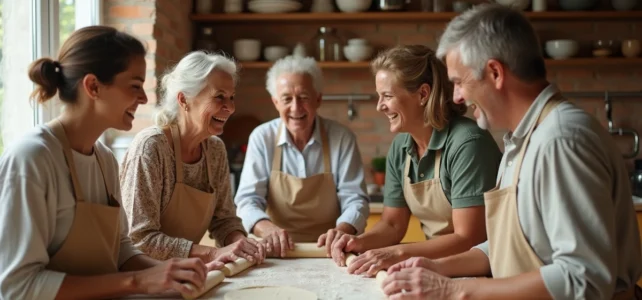
Several mental health prevention studies show that family bonds are woven in the micro-moments of daily life, those that we barely notice: a shared meal without screens, a cooking chore done together, a phrase addressing a difficult emotion.
Children’s participation in daily tasks is identified as a more effective protective factor than highly organized occasional activities. The challenge remains to understand which actions truly have an effect, and which are merely declarative.
Read also : Successfully Freezing Tabbouleh: Tips and Advice to Preserve Freshness
Shared meals and household tasks: two compared levers
Recommendations regarding family bonds often cite the same practices without prioritizing them. The table below contrasts two frequently mentioned daily habits, family meals and children’s involvement in tasks, summarizing what recent prevention studies report.
| Criterion | Family meals (without screens) | Participation in household tasks |
|---|---|---|
| Recommended frequency | Daily or nearly daily | Daily, age-appropriate |
| Main identified effect | Flow of conversation, protective informal exchanges | Sense of belonging, autonomy, quality of parent-child relationship |
| Current risk | Decreasing since the pandemic (meals in front of screens, irregular schedules) | Often perceived as a burden, undervalued |
| Accessibility | No materials, no cost | No materials, no cost |
| Relational benefit for the child | Trust, feeling heard | Competence, pride, cooperation |
Family meals remain one of the few moments where conversation truly flows between parents and children. In contrast, shared tasks develop relational skills that meals alone do not cover, particularly concrete cooperation and the feeling of contributing to the household’s functioning.
Related reading : Tips and news for better managing personal finances daily
Both practices are complementary, but the latter is largely underestimated by families seeking to strengthen their bonds. Cooking, tidying up, and preparing groceries together produce a measurable effect on the quality of the relationship, much more than a trip to the amusement park. Exploring the resources dedicated to family on Sous Tous les Angles allows for a deeper understanding of these dynamics from various angles.

Emotional communication in daily life: naming what is happening
The emotional climate of the home plays a direct role in the quality of family bonds. Child psychiatrists and psychologists increasingly emphasize that children absorb the emotional climate around them, whether it is economic stress, anxiety-inducing news, or tensions between parents.
The recommended gesture is simple in appearance: name what is happening, at the child’s level of understanding. There is no need to explain everything or turn every dinner into a therapeutic session. It is about putting brief words on a visible emotion.
Three concrete situations where verbalizing changes the dynamic
- A parent comes home tired and irritable: saying “I had a tough day, it’s not because of you” cuts short the anxious interpretation that the child builds alone.
- A frightening news story appears on television: rephrasing in one sentence what happened, then specifying what protects the family, restores the feeling of security.
- A conflict between parents occurred in front of the children: briefly revisiting it (“we argued, we found a solution”) shows that disagreement does not destroy the bond.
Naming an emotion in front of a child is a daily relational gesture that preserves trust. It is neither an admission of weakness nor an overload of information: it is a verbalization that prevents the child from filling the void with their own scenarios, often more distressing than reality.
Parenting workshops and communication tools: what exists in 2026
Family Houses now offer short-format workshops, in the evening or on weekends, allowing parents to practice tools for compassionate communication and management of intrafamily conflicts. These programs differ from traditional conferences by their practical dimension: they simulate situations and test formulations.
The goal is not to learn a theoretical method but to practice live. Parents leave with tested phrases, not with abstract principles. This format addresses a recurring difficulty: knowing what to say is not enough; one must have rehearsed the verbal gesture for it to become accessible under stress.
Limitations of these programs
Access remains unequal across regions. Large cities have a structured offer, while rural areas still rely on occasional associative initiatives. The main barrier identified by professionals is not cost (these workshops are generally free or at a symbolic price), but the difficulty in reaching parents who need it most, often those who do not frequent institutional structures.
Screens and irregular meals: what weakens family bonds
Since the pandemic, meals taken in front of a screen or at irregular times have multiplied in French households. This evolution directly weakens the informal exchanges that constituted a daily relational foundation. Meals without screens remain the primary tool for relational prevention, and they cost nothing.
The problem is not the screen itself, but what it replaces: a moment where each family member can speak without agenda, without objective, without educational filter. When this moment disappears, no compensatory activity (board games, cultural outings) produces the same effect of protective regularity.
Strengthening family bonds in daily life relies less on inventing new activities than on preserving two simple habits: eating together without distraction, and involving children in the concrete life of the household. The third lever, verbalizing emotions, requires learning, but it sustainably transforms the family climate. Shared meals, tasks done together, and addressing emotions form the concrete foundation of the parent-child relationship.