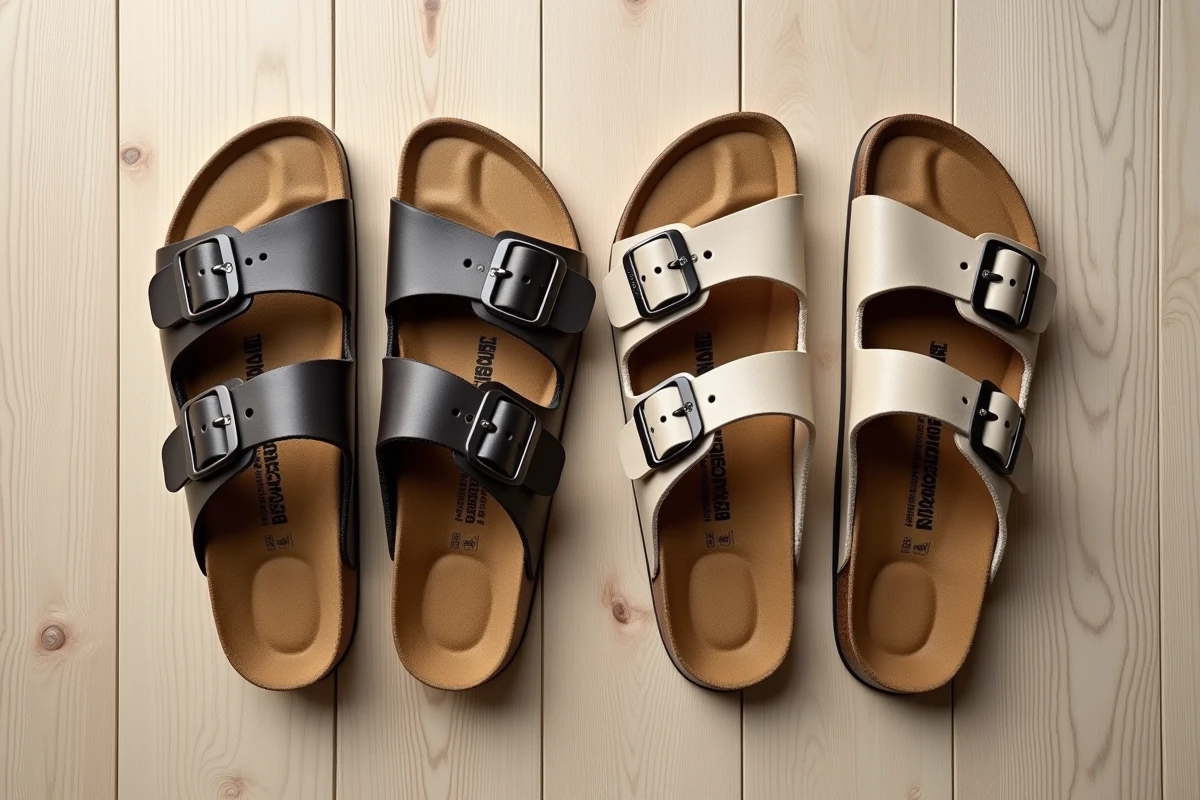
Scholl and Birkenstock occupy the same store aisle, often side by side, yet the two brands have almost nothing in common industrially. Scholl, historically linked to the medical world and podiatry, targets a broad audience with ranges updated each season.
Birkenstock, a German family brand founded in the 19th century, has built its reputation around a single concept of cork and natural latex soles. Comparing these two names solely on the basis of purchase price ignores what really weighs on the long-term budget.
Cork sole vs synthetic sole: how the material changes daily life
The fundamental difference between Scholl and Birkenstock plays out underfoot. Birkenstock uses a footbed made of natural cork combined with latex, a material that gradually deforms to fit the wearer’s morphology. This adaptation creates a unique mold after several weeks of use.
Scholl, on the other hand, relies on synthetic material soles (memory foam, EVA, rubber). The comfort is almost immediate, with no break-in period. The downside: the foam loses its density more quickly than well-maintained cork.
This choice of material has direct repercussions on longevity. A cork footbed retains its supportive properties significantly longer than synthetic foam, provided it is protected from water and occasionally nourished. User feedback on specialized forums varies on the exact duration, but the trend remains constant: Birkenstock cork ages better than Scholl foam.
To delve deeper into the technical specifics of each brand, a comparison of Scholl and Birkenstock shoes details the materials and constructions model by model.

Total cost of ownership over five years: Scholl and Birkenstock beyond the displayed price
The purchase price of a pair of Birkenstock is significantly higher than that of an equivalent pair of Scholl. This initial difference drives many buyers toward Scholl without calculating the actual long-term cost.
Actual durability and replacement frequency
A regularly worn Birkenstock sandal typically lasts several seasons before the outsole wears down to an inconvenient level. Resoling is possible at a cobbler or through the brand’s service, which extends the product’s life without having to buy a new pair.
On the Scholl side, the construction does not always allow for resoling. When the inner foam collapses, the pair loses its main appeal, comfort, and ends up being replaced. Over five years of daily summer use, you will need more pairs of Scholl than Birkenstock to maintain an adequate level of support.
Hidden costs to consider
- The Birkenstock break-in period sometimes requires the purchase of thick socks or band-aids during the first weeks, a detail rarely mentioned by the brand
- Birkenstock resoling represents a significant cost, but remains lower than buying a new pair
- Cork maintenance products (waterproofing spray, nourishing cream) add a few euros per year
Evaluating the total cost of ownership often changes the price hierarchy between the two brands. The cheapest model to purchase is not necessarily the cheapest to use.
Foot support and regulatory framework: the term “orthopedic” in question
Both Scholl and Birkenstock evoke foot well-being and arch support in their communication. Both brands offer shoes with a pronounced arch under the foot, distinguishing them from classic flat sandals.
The term “orthopedic” deserves special attention. Regulations increasingly govern the use of this designation for medical devices. Neither Scholl nor Birkenstock sell orthopedic shoes in the medical sense, except for specifically certified ranges. Both brands market comfort shoes with integrated foot support, which is different.
For people suffering from foot pain, this distinction matters. A Scholl or Birkenstock shoe may relieve mild discomfort, but it does not replace a custom orthopedic insole prescribed by a podiatrist. Available data do not allow us to conclude that one brand is clinically superior to the other in terms of postural correction.
Style positioning and women’s range: two opposing strategies
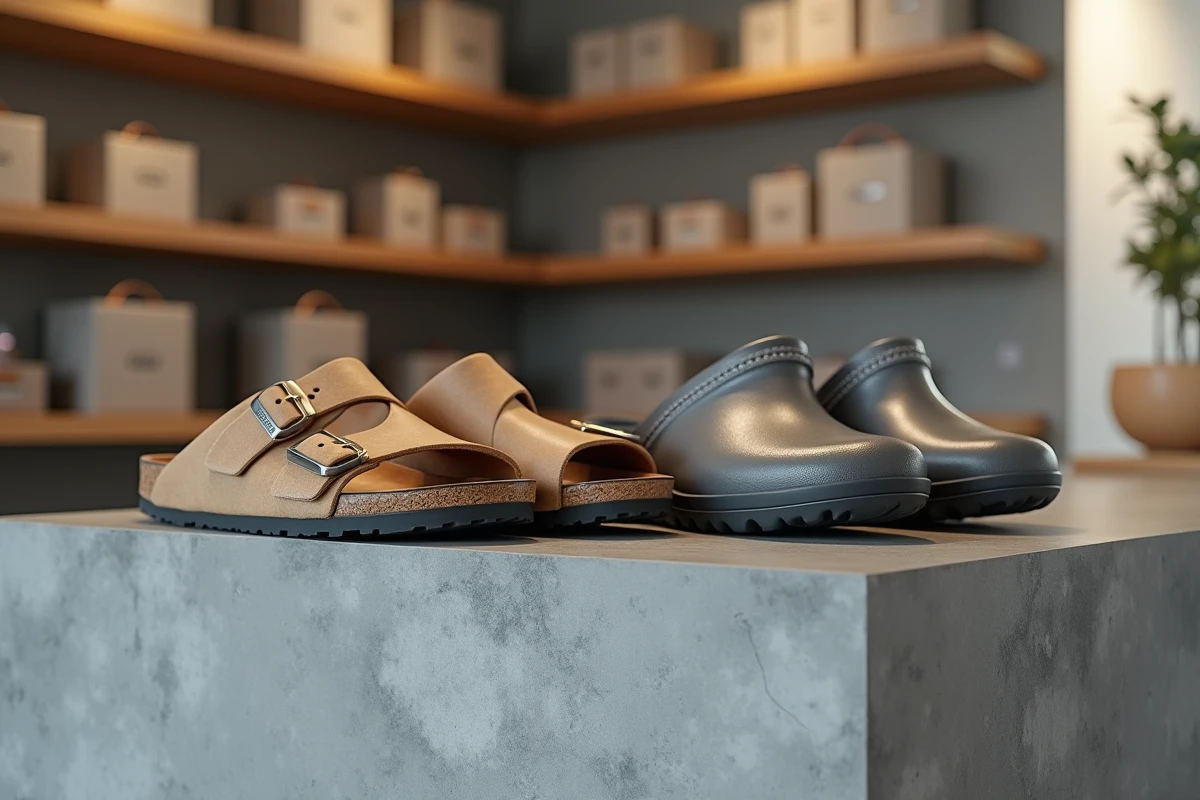
Birkenstock has made a spectacular fashion turn in recent years. The brand collaborates with luxury houses, and its Arizona or Boston models are featured in fashion magazines. The catalog remains deliberately tight: few models, sober colors, a recognizable silhouette.
Scholl adopts the opposite strategy. The women’s catalog is vast, with mules, clogs, wedge sandals, and sneakers. Collections change each season, following current trends. Scholl renews its models where Birkenstock capitalizes on timeless classics.
This positioning has a direct impact on resale. A second-hand Birkenstock retains residual value on second-hand platforms, driven by the brand’s reputation. An outdated Scholl after two seasons is difficult to resell, further increasing the total cost gap.
Choosing between Scholl and Birkenstock based on actual use
The choice between these two brands depends less on immediate budget than on intended use. For occasional wear on vacation, Scholl offers immediate comfort at an accessible price, with a variety of styles that adapt to current desires. For daily wear over several seasons, Birkenstock amortizes its price better thanks to its durability and possible resoling.
Those sensitive to natural materials and evolving arch support will lean towards Birkenstock cork. Those who prioritize lightness, no break-in period, and model diversity will find satisfaction with Scholl. The decisive criterion remains the relationship between the price paid and the actual number of comfortable usage seasons, a calculation that neither brand highlights on its product sheets.