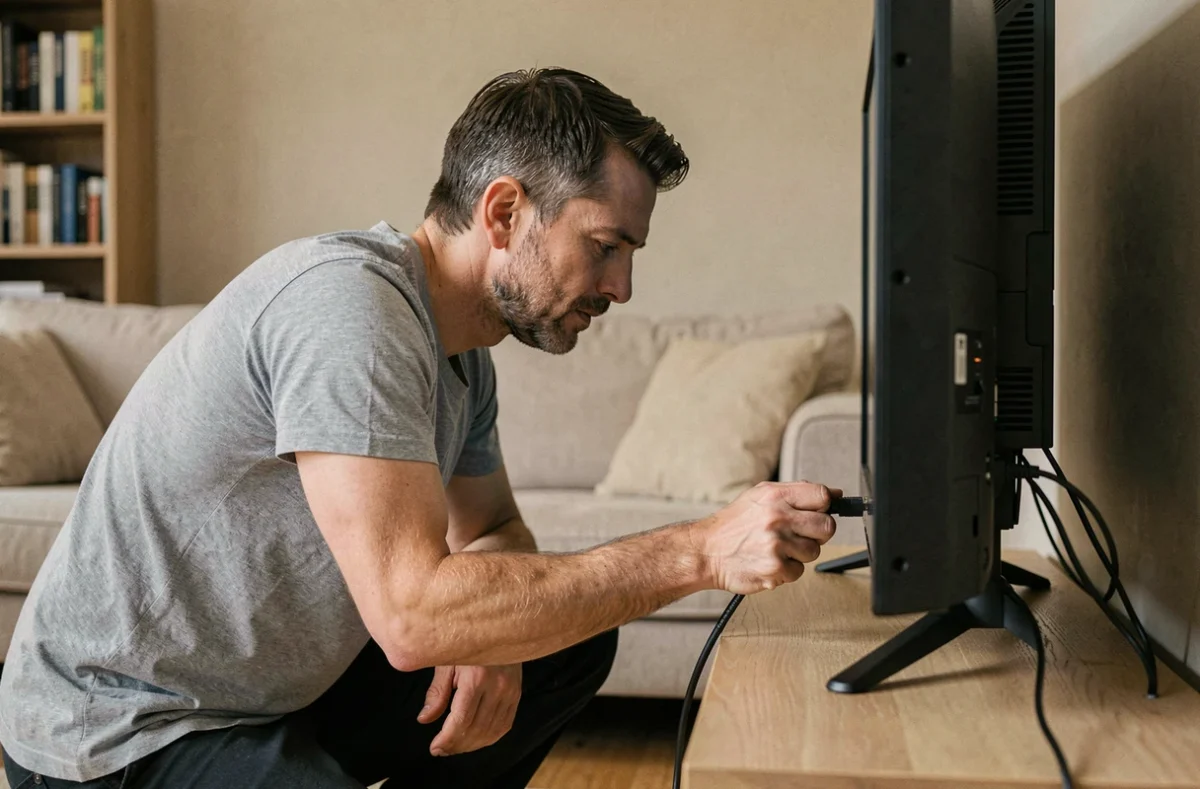
Connecting an IPTV service to a television involves a technical choice that directly influences image quality and stream stability: wifi or ethernet cable. Both options work, but they are not equal depending on the hardware you have. This article compares the two connection modes, identifies cases where one outperforms the other, and details the often-overlooked points of caution when connecting.
Ethernet or wifi on an IPTV television: performance comparison
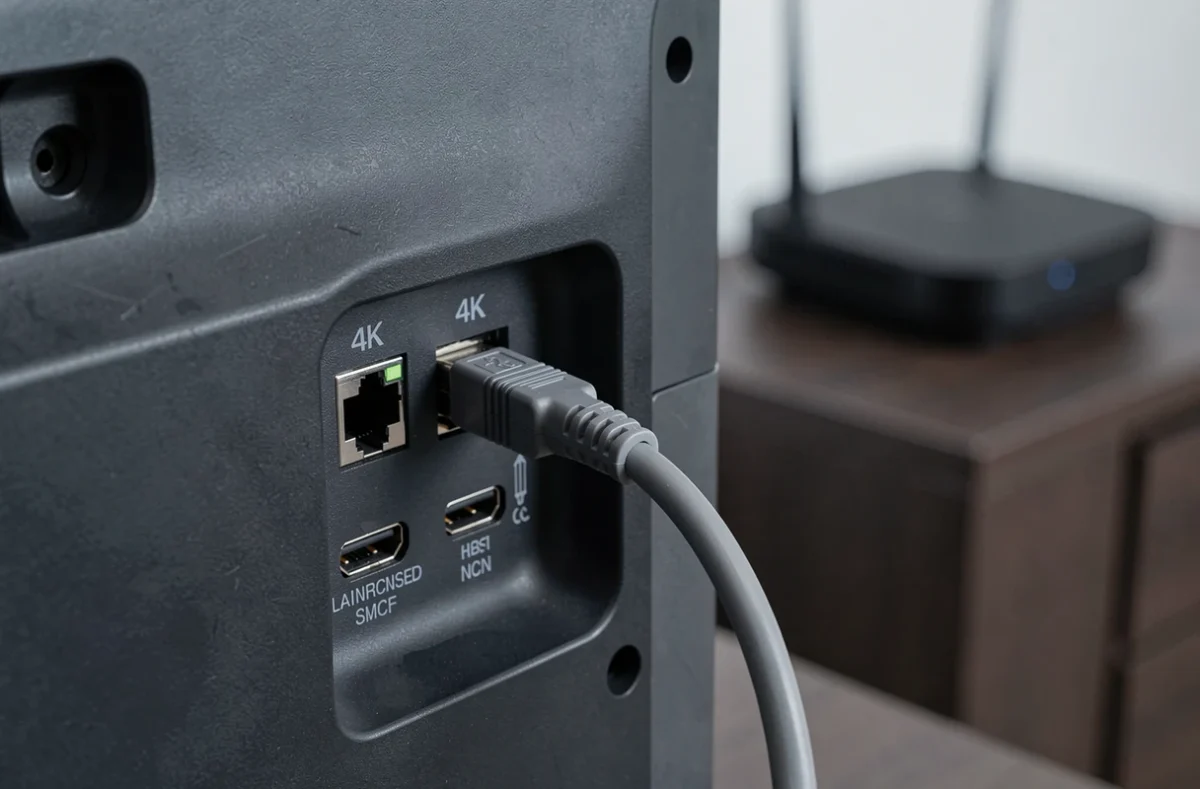
The logical reflex is to plug in an ethernet cable to ensure a stable bandwidth. This approach remains valid in most cases, but one technical detail deserves attention: some recent televisions limit their ethernet port to 100 Mbps, while their integrated wifi 6 module can exceed this speed (source: XDA Developers, September 2026).
| Criterion | Ethernet connection | Wifi connection |
|---|---|---|
| Stream stability | Very stable, no interference | Variable depending on distance to the router and obstacles |
| Maximum bandwidth | Limited to 100 Mbps on some televisions | Higher on wifi 6 (if the router is compatible) |
| Latency | Minimal and constant | Slightly higher, possible spikes |
| Installation | Cable to run to the television | No wiring, only software configuration |
| Sensitivity to disturbances | None | Neighboring devices, microwaves, thick walls |
The table shows that the choice depends as much on the television as on the home network. Check the specification of your television’s ethernet port before cabling to avoid disappointment: a port limited to 100 Mbps will gain no benefit from a gigabit fiber connection.
To understand how to connect IPTV via wifi or ethernet on different models of boxes, the procedure varies depending on the type of device used, but the basic principle remains the same: connect the decoder or box to the network, then configure the IPTV application.
IPTV connection via a decoder box: HDMI cable and network
Most IPTV installations go through an external box connected to the television via HDMI. This box (Android TV, dedicated decoder, or internet box with IPTV function) manages the decoding of the stream and the network connection.
Concrete steps for physical connection
- Connect the box to the television with an HDMI cable, then select the corresponding HDMI source on the television
- Connect the box to the network: either via an ethernet cable plugged directly into the router or a switch, or via wifi by entering the network password in the box’s settings
- Install the IPTV application from the box’s app store, then enter the credentials or server address provided by the service provider
- Test the playback of a channel to check the fluidity before finalizing the settings (resolution, audio language, subtitles)
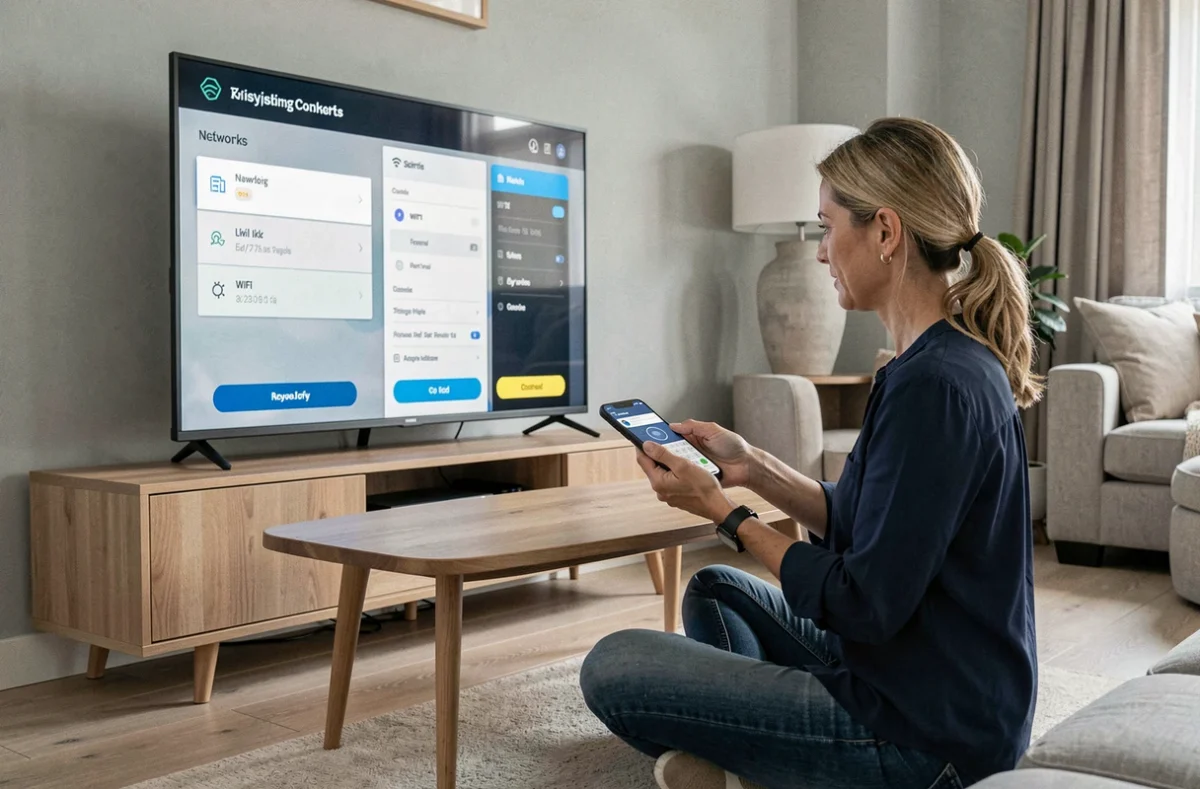
On a connected television (smart TV), the external box is not always necessary. The IPTV application can be installed directly from the integrated app store. The network is configured in the television’s system settings.
Case of non-connected televisions
A television without smart functions necessarily requires an intermediate box. The most common options are Android TV boxes or compact HDMI sticks. The box handles the internet connection (wifi or ethernet) and the execution of the IPTV application.
Configuring the home network for a stable IPTV stream
The physical connection is not enough if the home network is not properly sized. A high-definition IPTV stream consumes between 5 and 8 Mbps per active channel (hotel data applicable to residential use). In 4K, the requirement rises to 25 Mbps and more per simultaneous stream.
If multiple devices share the same internet connection (computers, smartphones, other televisions), the available bandwidth for IPTV decreases. Two network adjustments reduce interruptions and buffering.
Traffic prioritization on the router
The QoS (Quality of Service) feature present on most recent routers allows prioritization of video streams. Specifically, the router reserves a portion of the bandwidth for the IPTV box, even when other devices are downloading simultaneously. This option is generally found in the advanced settings of the router’s administration interface.
Router positioning for wifi
In a wireless connection, the distance between the router and the television directly affects quality. A load-bearing wall or a floor between the two can halve the bandwidth or more. A wifi repeater or mesh system improves coverage without additional wiring, but adds slight latency compared to a direct connection.
IPTV and legality: what the connection doesn’t tell you
The technical connection of an IPTV box is legally neutral. IPTV is not illegal in itself: it is the lack of broadcasting rights for the content that makes a service illegal. A low-cost subscription offering hundreds of premium channels does not guarantee any legality, even if the application is downloadable from an official store.
Blocking measures in France are no longer limited to domain names. Since September 2026, measures also target mirror sites and certain IP addresses, with blocks that can be updated in real-time during sports broadcasts (source: Freenews). Changing DNS or activating a VPN does not make a service legal and becomes an increasingly unreliable workaround.
Another often-overlooked risk concerns IPTV applications installed outside official stores. APK files from unknown sources can compromise the device, beyond just cutting off the service. Prioritizing applications available on Google Play or the television’s App Store reduces this exposure.
The choice between wifi and ethernet for connecting IPTV to your television ultimately depends on two simple checks: the specification of your television’s ethernet port and the quality of your wifi coverage. A cable remains the most reliable choice in most configurations, except when the television’s port throttles the bandwidth below what wifi 6 can offer.