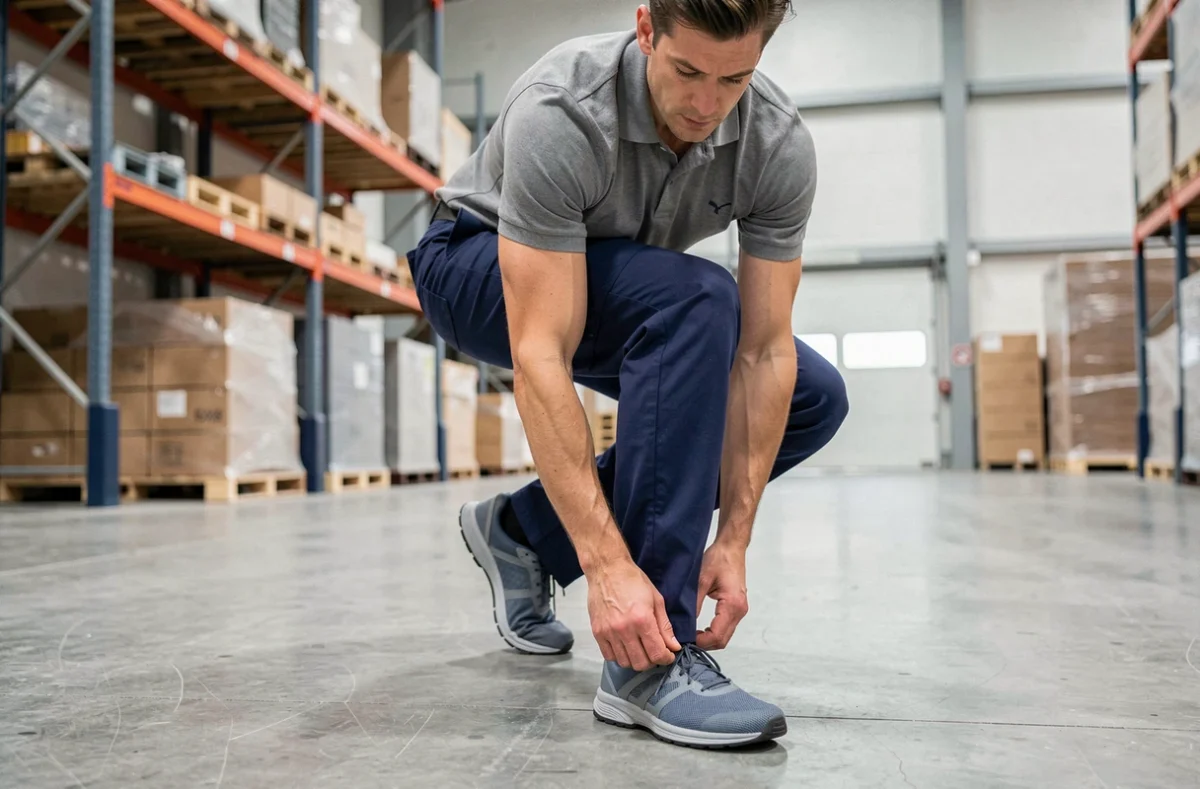
On a a construction site in the middle of summer or in a logistics warehouse where one walks fifteen kilometers per shift, the weight of safety shoes becomes as critical a factor as the protective toe cap. Choosing lightweight and comfortable safety shoes for men starts with understanding what adds weight to the model, then balancing protection, flexibility, and durability according to the actual constraints of the job.
Textile or metal anti-perforation insert: what really changes underfoot
We often talk about the weight of the toe cap (composite versus steel), but the anti-perforation insert weighs just as much in the comfort balance. The EN ISO 20345:2022 standard now distinguishes three markings: P for a metal insert, PL and PS for non-metallic inserts. The difference is not limited to just a few grams less.
A textile insert (PL or PS) reduces the rigidity of the sole. On uneven ground, the foot better follows the terrain, and muscle fatigue decreases by the end of the day. However, the coverage of the foot’s surface can vary from one manufacturer to another: some textile inserts do not protect the edges of the foot as widely as a stainless steel plate.
To consult a guide to lightweight safety shoes for men that compares recent models incorporating these different inserts, it saves time on the initial selection.
On the ground, the choice depends on the actual risk of perforation. A warehouse worker walking on smooth floors does not have the same needs as a carpenter exposed to nails. When the risk of perforation is low, a model without an insert (marking S1 or S3 without P) remains the lightest and most flexible option.
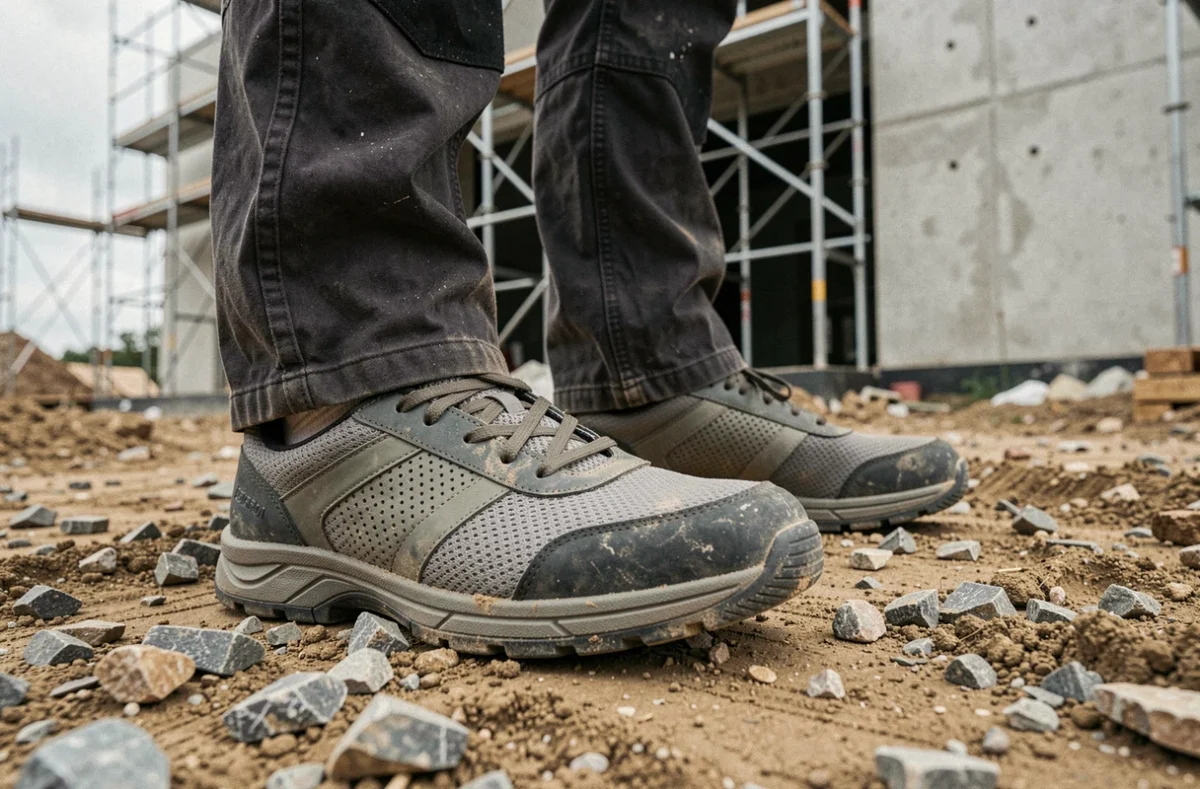
EN ISO 20345:2022 standard: how to read a safety shoe technical sheet without making mistakes
The old classes S1, S2, S3 still exist, but the 2022 standard (supplemented by amendment A1:2024) adds classes S6 and S7 for waterproof models across the entire shoe. For outdoor work exposed to moisture, these new classes replace what was previously achieved with greasy leather and random water-repellent treatment.
Another change to know: resistance to hydrocarbons (marking FO) is no longer automatically included in classes S1, S2, and S3. A mechanic or workshop operator must check that the FO marking is explicitly mentioned on the technical sheet. Without this mention, a lightweight shoe classified S3 does not necessarily protect against oils.
Grip and marking SR: what has changed
The old indicators SRA, SRB, and SRC still appear on models in stock, but the 2022 standard incorporates basic grip into the general requirements. The SR marking now corresponds to an additional test on tiled floors with glycerin. Comparing two pairs of safety sneakers by relying solely on the SRC mention of an old model and the SR marking of a recent model is comparing two different benchmarks.
Reading the complete technical sheet (and not just the marking on the tongue) remains the only reliable way to compare models with each other.
Lightweight safety shoes for men: the comfort criteria that matter for a standing position
The weight indicated by the manufacturer gives an indication, but it does not tell the whole story. Two pairs with the same weight can offer very different sensations depending on the distribution of mass, the height of the drop, and the density of the midsole.
Here are the points to check before buying:
- The midsole made of EVA or expanded PU absorbs shocks on hard ground. You can distinguish it by pressing your thumb under the shoe: if the material does not return, the cushioning will be nonexistent after a few weeks.
- The fit around the instep and arch: a model that is too wide allows the foot to slide, while a model that is too narrow compresses the forefoot and causes metatarsal pain within the second hour.
- The removable insole: being able to replace it with an orthopedic insole or simply wash it extends the lifespan of comfort. In a position where one sweats a lot, this is a selection criterion that weighs as much as the weight.
- The upper made of mesh or technical textile: more breathable than full-grain leather, it is suitable for dry and temperate environments. However, it offers less resistance to abrasion and water.
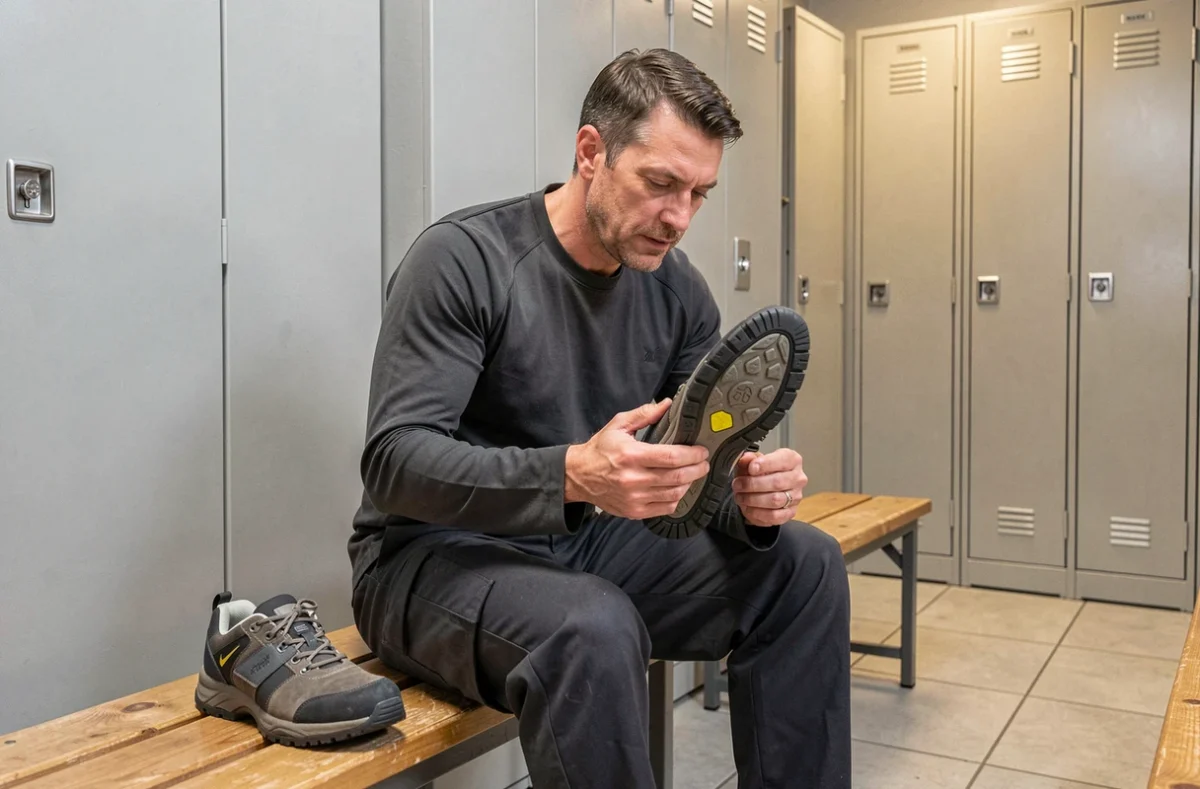
Men’s safety sneakers: a real compromise between style and protection at work
Safety sneakers are appealing because they look like sports shoes. They are more willingly slipped on, and are sometimes worn on the commute to work. The perceived comfort is immediate.
The compromise lies in the foot’s stability over time. A low-top safety sneaker does not stabilize the ankle like a high-top shoe. On cluttered or sloped ground, the risk of spraining increases. Feedback on this point varies according to body types: a narrow foot with good proprioception will adapt better to a low top than a wide and flat foot.
For indoor environments without major twisting risks (logistics on flat floors, light industry, IT maintenance), the S1 safety sneaker with a composite toe cap represents the best weight-comfort-protection ratio. As soon as you move outdoors, on muddy or uneven terrain, a high S3 model with a textile anti-perforation insert regains the advantage.
Durability and replacement
A pair of lightweight safety shoes wears out faster than a heavy all-leather model. The midsole loses its cushioning, the mesh tears, the composite toe cap does not deform but the adhesive may fail. Planning for regular replacement is part of the calculation: two lightweight pairs in rotation last longer than one worn every day.
The final choice comes down to the level of protection required by the job, the applicable standard (verified on the technical sheet, not on the box), and the comfort felt during a fitting at the end of the day, when the foot is slightly swollen. It is in this order that one avoids unpleasant surprises.