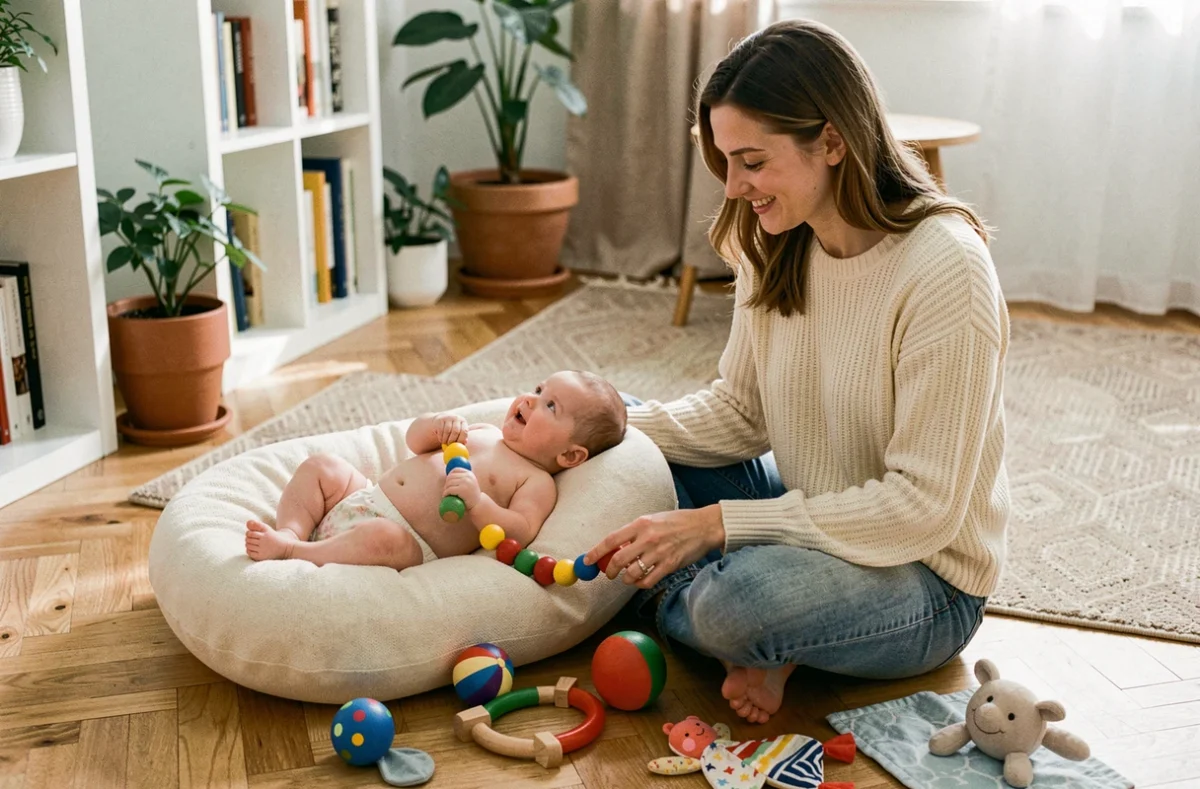
The baby toy market offers thousands of products grouped by age range. This information, which must appear on the packaging, is based on the European Toy Safety Directive, which sets thresholds for physical risks such as small parts, cords and materials. However, it says nothing about whether a toy is suited to a particular child’s actual abilities. The gap between regulatory compliance and developmental suitability is the starting point for making a more thoughtful choice.
Baby toy safety: what the age label doesn’t cover
“From 3 months” or “from 6 months” means that the toy has been assessed to ensure it poses no mechanical or chemical hazard at that age. It does not guarantee that the child will find the toy interesting or that it will engage the right skills at the right time.
A baby who puts everything in their mouth calls for an additional consideration that the label doesn’t mention: the condition of the toy after several weeks of use. A seam coming undone on a fabric book, a poorly secured battery compartment, or a silicone piece coming loose from a well-chewed rattle—these problems can arise after purchase. Regularly inspecting toys and removing any that show signs of wear is a more protective habit than simply following the age recommendation.
Toys intended for the first few months also deserve careful consideration when it comes to materials. Manufacturers specializing in baby products, such as those featured in Ouaps’ baby section, design ranges made to withstand repeated handling and mouthing.
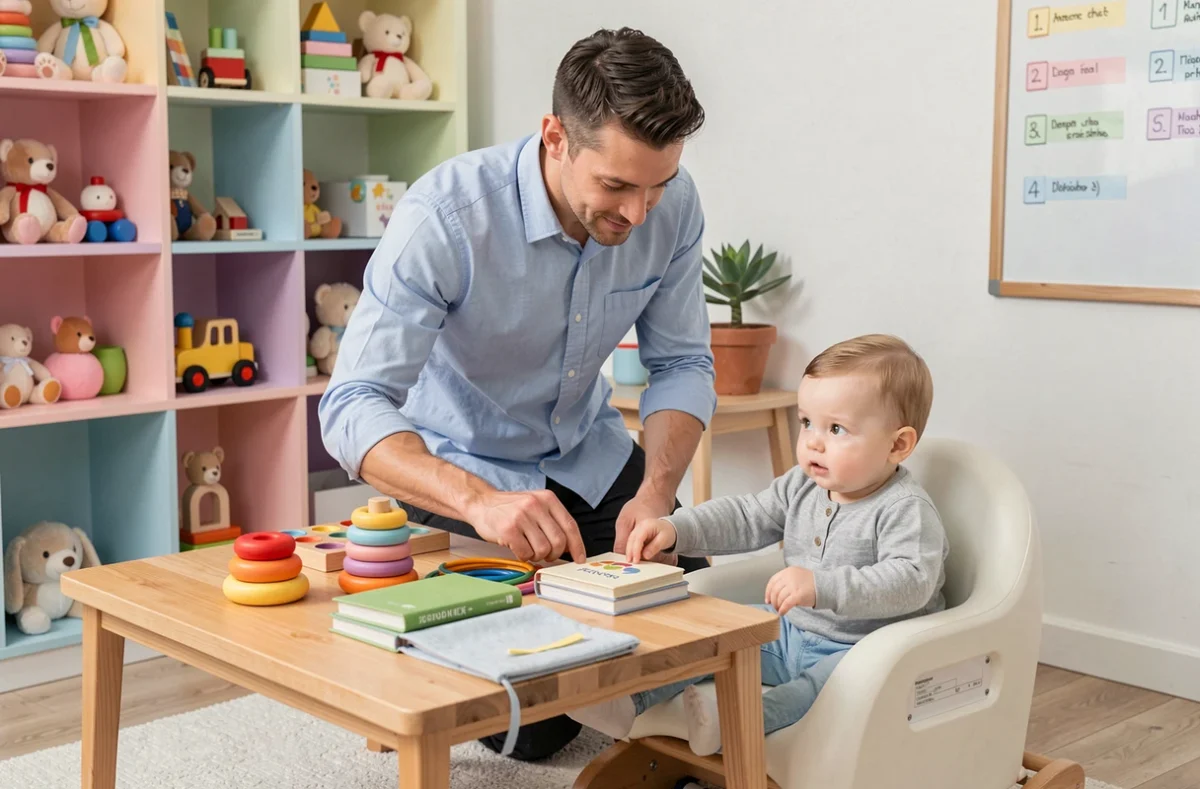
Developmental toys for ages 0–6 months: stimulate without overwhelming
During the first few months, a baby’s visual system has difficulty processing bright colors and fine details. Babies first perceive strong contrasts, especially black and white, and then gradually expand their visual palette. High-contrast cards make use of this by capturing their attention without causing visual fatigue.
One simple, well-chosen toy is more stimulating than a pile of objects. The rattle remains a classic because it combines three functions in one: grasping (the hand learns to hold), auditory feedback (the sound confirms the action) and oral exploration (the baby puts it in their mouth to discover its shape).
An activity gym, often presented as a must-have purchase, is only truly useful if the child spends time on the floor on their tummy. Its value depends less on the hanging accessories than on having an adult nearby to talk, point things out and wait for the baby’s reactions.
The sensory overstimulation trap
Adding lots of textures, sounds and lights to a single toy can have the opposite effect to the one intended. An overstimulated baby may look away, become restless or cry. Two or three toys in rotation are better than ten left within easy reach. Switching the available toys each week renews the child’s curiosity without cluttering the space.
Toys for babies aged 6 to 12 months: supporting motor skills
Between six and twelve months, most babies progress from sitting to standing, often moving through crawling along the way. This motor development radically changes how they interact with objects. A toy placed just out of reach can motivate them to move.
- Stacking toys (cups, rings on a post) develop hand-eye coordination and introduce concepts of size and order. They work in reverse, too: babies enjoy knocking down a tower just as much as building it.
- Soft rubber bath toys offer a different kind of sensory exploration through contact with water. They should be emptied and dried after each use to prevent mold from forming inside—a point rarely mentioned on the packaging.
- Board books with lift-the-flap pages develop fine motor skills (the pincer grasp) and introduce cause and effect. Choose books with thick pages, as babies this age can easily tear standard paper.
Fine motor skills develop through repeatedly handling simple objects, not through toy complexity. Turning a wooden cup upside down over a hidden ball teaches object permanence just as effectively as a twenty-function electronic toy.
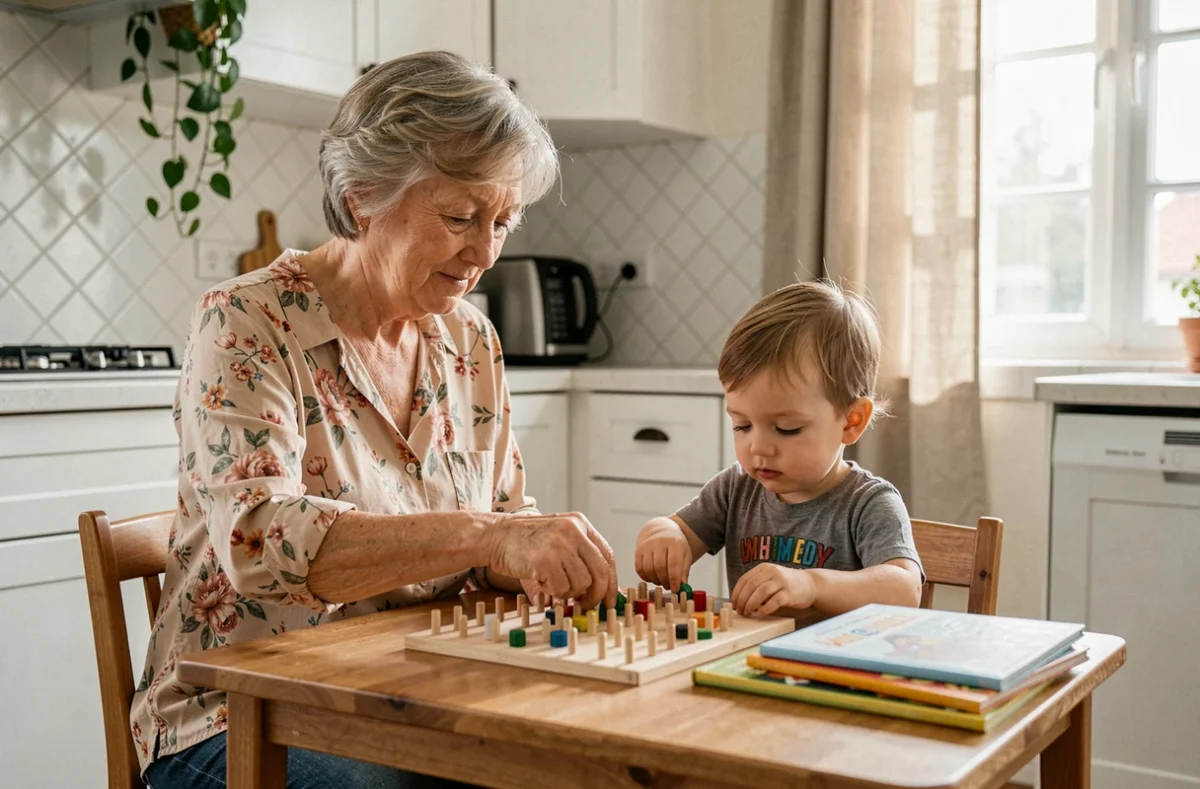
Choose a toy for the child, not just their age
The age ranges printed on boxes reflect statistical averages. An eight-month-old who isn’t crawling yet won’t get the same benefit from a ride-on toy as a child of the same age who is already mobile. Observing what a child does with an object spontaneously provides more reliable information than the manufacturer’s recommendation.
A few signs can help you assess whether a toy is a good fit:
- The baby explores it for several minutes without help: the toy matches their current abilities.
- They lose interest within seconds: the toy may be either too simple or too complex for their developmental stage.
- They use it in an unexpected way (tapping, throwing or biting it instead of stacking it): they are adapting the object to what they know how to do, which is still a valid form of learning.
Playing together with an adult multiplies the value of a basic toy. Naming actions, imitating the baby’s movements and introducing variations (hiding the object or rolling it in another direction) enrich the interaction without requiring any additional purchases. A baby doesn’t need twenty developmental toys. They need a few well-chosen objects and an adult who is available to play with them.
Choosing a baby toy is best guided by direct observation rather than marketing. A toy suited to the child’s actual development, inspected regularly and used in interaction with an adult, can support learning and development far beyond what its packaging promises.